Printable cursive practice sheet
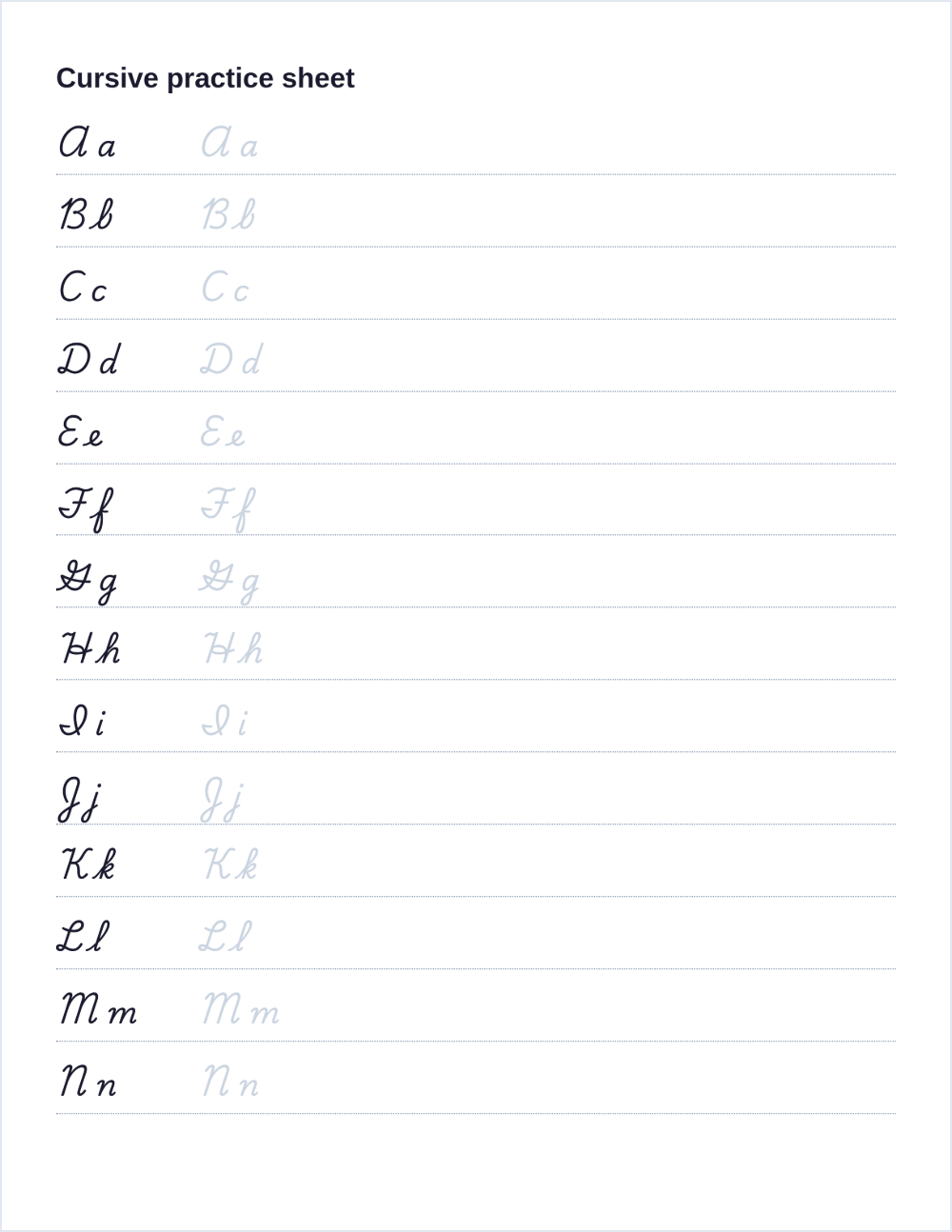
One click prints an A–Z page where each row shows the cursive model letters plus space to trace and repeat them: ready for the classroom, homeschool, or your own practice.
Cursive letters A–Z
Tap a letter to see its capital and lowercase cursive form, print a large single letter, or download a PNG. Prefer copy-paste cursive text for a bio? Use the cursive fonts generator.
Writing a name in cursive?
Type any name on the cursive name tracing worksheet page to print it joined up, with a model row, faded rows to trace and one sheet per child for a class. Or start from a ready-made word: Mom, Dad, Love, Happy Birthday, Best Friend, and Family in cursive.
Cursive letters chart: every capital and lowercase form
All 52 forms of the cursive alphabet at a glance. Tap any pair for that letter's full guide with stroke-by-stroke steps; use Download PDF above for a printable A–Z chart.
The four cursive letter families
Cursive is easiest taught in families that share an opening movement, not in A-to-Z order. The undercurve family (i, u, w, t, r, s, j, p) swings up from the baseline and is where beginners start. The overcurve family (m, n, v, x, y, z) enters over the top. The oval family (a, c, d, g, o, q) opens with the same curve-left oval. The loop family (l, b, e, f, h, k) rises into a tall loop. Master one member and its siblings come almost free. The full teaching order is in our guide, Cursive: when to start and which letters to teach first.
Cursive capital letters: the ones that surprise everyone
Most cursive capitals are recognizable, grander versions of print. Four are not: the capital G (a compound curve that looks nothing like print G), the capital Q (classically written like a large 2), the capital S (a swan-like double curve), and the capital I (an ornate compound stroke). Each letter page shows the capital form large, explains how it is written, and prints both cases on one sheet. Teach lowercase first, it is most of real writing, then bring capitals in through the child's own initials.
Cursive letter guides A–Z
Every letter has its own page with the capital and lowercase forms, stroke-by-stroke steps, the common mistake to avoid, and a printable you can save as a PDF.
Learning cursive from the practice sheet
Print the practice sheet and trace each model letter until the joins feel natural, then move to the blank space to write it freehand. Study how each capital connects, and keep sessions short and frequent: a few letters a day beats one long sitting.
Printable cursive vs. copy-paste cursive
These sheets are for paper: tracing and handwriting. If you want cursive text you can paste into an Instagram bio, a caption, or a document, use the cursive text generator, which turns your words into copy-paste Unicode script. For lettering on skin, the tattoo font generator adds script families and size tests. Prefer ornate blackletter? See the calligraphy practice sheets.
Want cursive you can copy and paste?
Type once and copy flowing Unicode script for bios, captions, names, and signatures.
Open the cursive text generator →