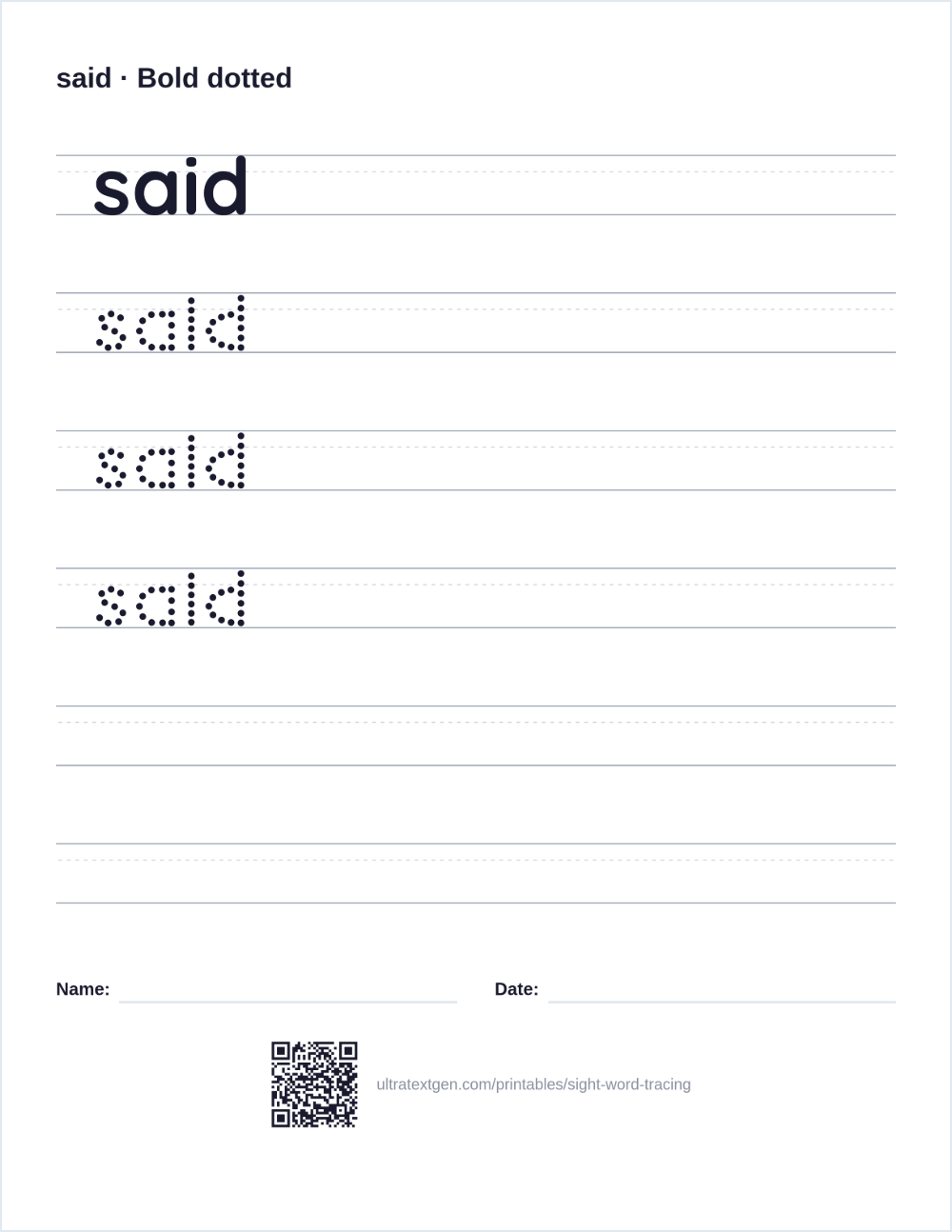
Every Dolch sight word, pre-primer to third grade, and the first 100 Fry words. Pick one or print a
whole list, dial the difficulty from bold dotted letters to a blank line, and watch the sheet build
live. Free, no sign-up, print or save a PDF/PNG.
Build a sight word worksheet
Pick a sight word from the Dolch lists or tap a sample below, choose a difficulty level, and the sheet builds live on the right. Print it, save a PDF, or download a PNG: free, no sign-up.
Try
Reading stage (optional shortcut)
Difficulty level (tap one, nudge up as they improve)
Building at Level 2 · Bold dotted: thick, closely-spaced dots to join.
Whole list: one sheet per word
Tap a list to load it. Download PDF then builds one worksheet per word at the difficulty picked above and saves the whole packet as one PDF. Download PNG saves the single word picked above. For your own word list, use the handwriting worksheet generator.
Live preview
Runs entirely in your browser: nothing is uploaded. Download PDF keeps a copy you can print any time.
What are sight words, and why trace them?
Sight words are the small set of very common words (the,
said, was, you, are) that
show up so often in early reading that kids are taught to recognize them instantly, by sight,
rather than sounding them out letter by letter. Many classrooms build this list from the
Dolch or Fry word lists, which group high-frequency words by
reading stage from Pre-K through third grade. Tracing a sight word while saying it out loud
connects the shape of the word to its sound, which helps it stick as an instantly-recognized
whole rather than a word to decode every time.
Not sure where to start? As a rule of thumb, Pre-K works well with bold dotted
letters on short words like "a" and "the", Kindergarten with fine dotted,
Grade 1 with dashed, and Grade 2 and up with a faint guide
before writing the word solo. The reading-stage buttons jump to a sensible level, then
fine-tune with the difficulty ladder above.
Sight words are common words (like "the", "said", and "was") that early readers are taught to
recognize instantly, without sounding them out. Many classrooms use the Dolch or Fry word lists,
which group these high-frequency words by reading stage from Pre-K through third grade.
Pick a word from the Dolch list menu or tap one of the sample words, choose a difficulty level from
bold dotted letters to a blank line, then click Download PDF. The sheet
includes a solid model row, several rows to trace, and blank ruled lines for writing the word
from memory. You can also download it as a PNG.
Start with short, very common words like "the", "and", "a", and "said", then work up to longer
ones like "little", "friend", and "where". The reading-stage buttons, Pre-K through Grade 2+,
jump the tracing difficulty to a sensible starting point for each stage.
Yes, completely free, with no sign-up, watermark, or limit. Everything is generated in your
browser, so you can make as many sight word worksheets as you like.
Yes. Open Whole list: one sheet per word and tap a list: Dolch pre-primer (40 words), primer (52),
first grade (41), second grade (46) or third grade (41), or the Fry first 50 or second 50. Download PDF
builds one worksheet per word at your chosen difficulty and saves the whole packet as one PDF, free, with no email required.
No. This page keeps to the Dolch and Fry lists, so every sheet it prints is a real sight word at a known reading
stage. For any other word, this week's spelling list or a sentence, use the
handwriting worksheet generator, which has the same seven
difficulty levels.