What the study found
-
156 of 156
name and worksheet pairs kept every accent on the six print-style worksheets
English, French, Spanish, German, Polish and Turkish name tracing, 26 names each, in the preview, the saved PDF and the PNG. The result was the same in all three runs.
-
16 of 26
names were damaged on the cursive worksheet before the fix
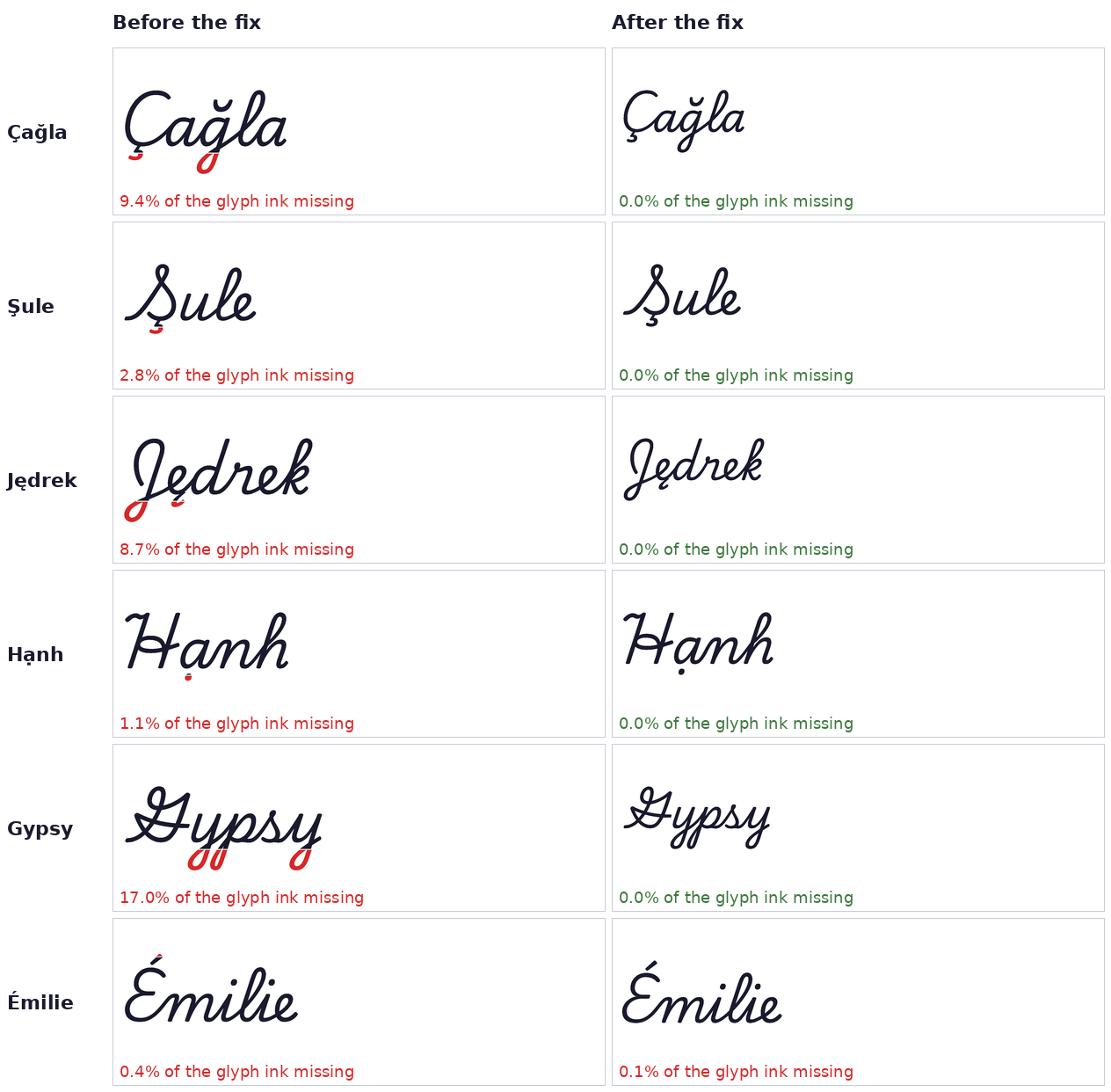
Twelve lost the bottom of the glyph at a straight line (cedillas on Ç and Ş, dots below, the loops of g, j, p and y). Four lost about 0.03 inch off the tip of a capital’s accent. Up to 17.5% of a name’s ink was missing. The live preview cut 13 of the 26.
-
158 of 280
name and page pairs were cut on eight cursive pages
English, Spanish, French, Italian, Portuguese, Polish, Dutch and Indonesian cursive pages cut 16 to 22 of 35 names each. The six calligraphy and gothic pages cut none (0 of 210), so the fault belongs to the cursive typeface and its box, not to accents in general.
-
0 of 490
name and page pairs were cut after the fix
The same 14 pages and 35 names, re-run on the fixed code. The 182 worksheet cells, the 63 extra below-the-line names and the 540 settings cells found no ink cut off either.
-
74% to 90%
of the old letter size is what a cursive name that needed room now prints at
The box grew from 200 to as much as 270 units tall, and the row keeps its height, so the letters shrink to fit. A name that already fit, such as Emma, is unchanged. Whether the smaller letters trace as well is not known.
How to read these numbers
These are counts of test names on our own pages, in one browser, judged by a computed check and not by a person looking at each sheet. They show that the page drew the font’s accents, not that every name, device or printer will. Nothing was printed on paper, and we did not test Windows, Apple or Android systems.
What this means for you
- Making a sheet with accents? Type the name with its accents on any of the six print-style worksheets. We found nothing cut, including a name typed as a letter plus a separate accent mark. Product implication
- Making a cursive sheet? The fix is in. Before it, names with Ç, Ş, ę, ạ, ș or a letter that drops below the line printed with the bottom cut off. If you saved a cursive PDF earlier, look at those letters again. The PNG download was never affected. Product implication
- A long cursive name looks a little smaller? That is the fix. The box now holds the whole name, so the row scales it down to fit; the figures below say how much. Choose a shorter name or a larger paper size if you need bigger letters. Interpretation
- Building something that draws text in a fixed-height box? Measure the ink, not the font’s nominal height. Accents and descenders of script fonts reach 78 units below the baseline in a box that ended 19 units under it, and a clipped box shows no error. Product implication
What we tested
Seven name worksheets, each typed with the same 26 names: plain controls (Emma, a single letter, Christopher), French, Spanish, Portuguese, German, Polish, Turkish and Vietnamese names with accents, an accent typed as a letter plus a separate mark (E and a combining acute), five capital É in a row, and a long double-barrelled name. Each cell is one worksheet with one name, captured as the preview, the saved PDF, the canvas the PDF is made from and the PNG download.
| Worksheet | Page | Paper by default |
|---|---|---|
| English name tracing | /printables/name-tracing/ | US Letter |
| English cursive name | /printables/cursive-name/ | US Letter |
| French name tracing | /fr/imprimables/prenom-a-tracer/ | A4 |
| Spanish name tracing | /es/imprimibles/nombre-para-trazar/ | A4 |
| German name tracing | /de/zum-ausdrucken/namen-schreiben/ | A4 |
| Polish name tracing | /pl/do-druku/pisanie-imienia/ | A4 |
| Turkish name tracing | /tr/yazdirilabilir/isim-yazma-calismasi/ | A4 |
Seven worksheets times 26 names is 182 cells per run. We added nine names with marks below the baseline (a dot below, an ogonek, a cedilla, a comma), run twice on all seven worksheets; a 540-cell sweep of paper size, orientation, row count, margins and ink settings; and a browser probe over 14 script-face pages and 35 names that asks the page directly whether it cuts text off.
What we found before the fix
On the six print-style worksheets nothing was cut, in any of the three runs. On the English cursive worksheet 16 of 26 names were flagged, with the same verdict every time. Twelve show a clean straight cut: everything missing lies below one horizontal line. The other four lose a few pixel rows off the top of a capital’s accent. The pictures below show the saved PDF’s model row for six names, with the ink the page cut drawn in red.
The cut spares nothing in the 35-name browser probe either. The probe loads each page, draws it with the box clipping the text and again with the box open, and counts ink that appears only in the second picture. It measures the page itself and does not depend on the PDF or on our comparison check. Measured in a browser
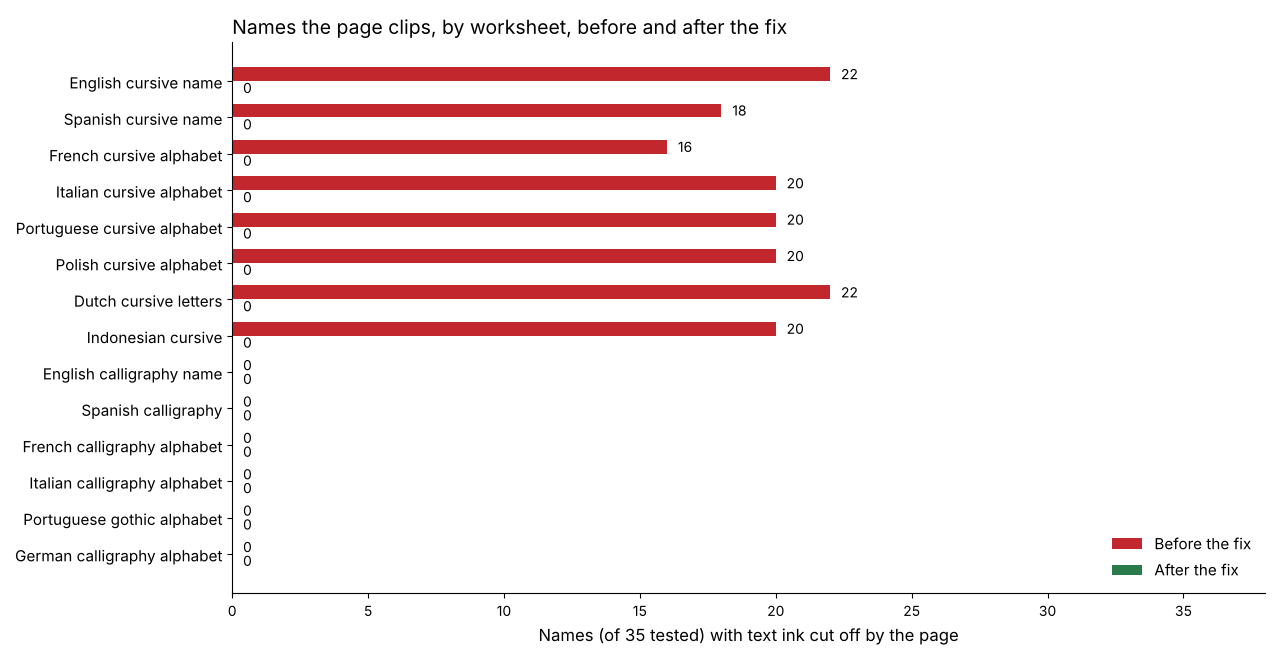
Marks below the line were the sharpest case
Before running the fix we wrote down a prediction (see the predictions table): if the cause is a fixed-height box, marks below the baseline will be clipped on the cursive worksheet and not on the others. We ran nine extra names twice on all seven worksheets. The cursive worksheet was flagged on all 9 in both runs; the six others on 0 of 54. In the cursive runs only about 40% of each below-the-line mark survived (the weakest mark region was 38% to 46% present). The two names with no marks at all, Zoe and Gypsy, were cut on cursive too, which points at the box and not at the accent.
Why it was cut
Each row of a name sheet is an SVG picture with a fixed view of 200 units from top to bottom. The text sits on a baseline at 181, so the box ends 19 units below the line the letters stand on. Print letterforms fit in that space. The cursive typeface (Playwrite US Trad) hangs the loops of y, p, g and j 78 units under the baseline, and an SVG that is too small hides what falls outside it, with no error. The drawing below is to scale, using the font and the page’s own measurements.
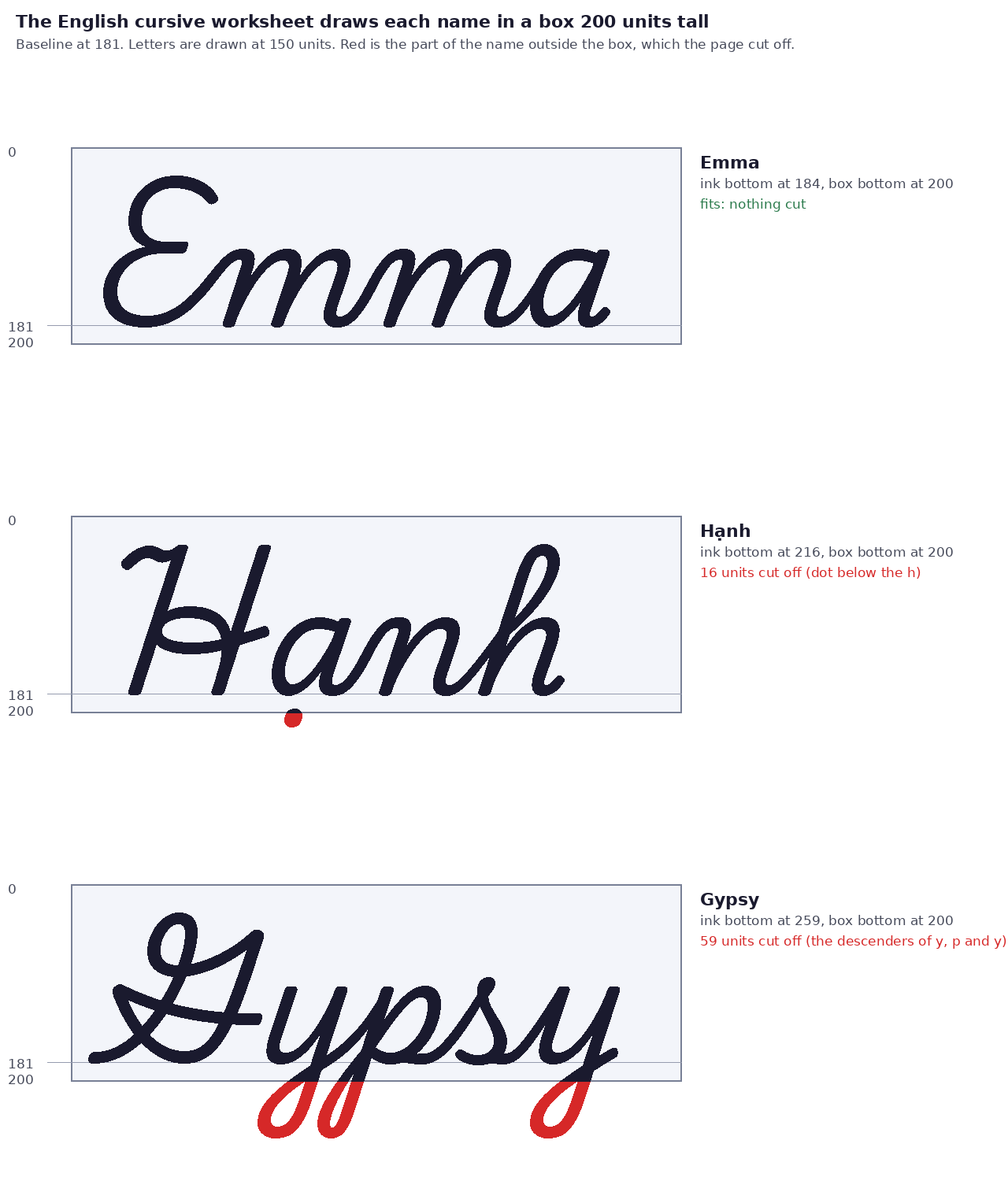
The PNG download draws on its own canvas with room for the whole name, which is why it was never cut. The routed cursive sheets (for example happy birthday in cursive) had already been given a taller box in September for the same reason; the plain name pages had not. Interpretation
The fix and what it changed
The change is one routine in the shared printables engine. Every unrouted name row now measures the name’s own ink and grows its box only when the ink overflows the box the row will really have, by more than 6 units. Pages that already fit keep their geometry. Three earlier versions were tested against the commit before the fix and rejected: one resized working print pages by about 5%, one moved the French ruled worksheet, and one left the French cursive page cut.
We compared the preview box of every one of the 58 pages that take a typed name, for 10 names, before and after: 580 page and name pairs. 71 changed, all of them on the eight cursive pages. The print and calligraphy pages did not change. 2 other pairs, a Vietnamese name on two bubble-letter pages, differed in the comparison run. Six fresh loads of each version gave identical boxes for both, so that is font files loading in a different order, not the fix.
| Name | Box height before | After | Letters print at |
|---|---|---|---|
| Emma | 200 | 200 | 100%, unchanged |
| Émilie | 200 | 221 | 90% |
| Hạnh | 200 | 227 | 88% |
| Şule | 200 | 233 | 86% |
| ẾẾ (stacked marks on capitals) | 200 | 242 | 83% |
| Christopher, Gypsy, Çağla, Jędrek, Nguyễn | 200 | 270 | 74% |
Table: the English cursive worksheet’s preview box, from viewbox-before-after.csv. The row keeps its height on the page, so a taller box means smaller letters. Measured from the page That is the price of the fix. We do not know whether a child traces a name 74% of the old size as well; that needs a teacher or a classroom. Unresolved
After the fix
On the fixed code the browser probe found no cut text on any of the 14 pages and 35 names (0 of 490, against 158 before). The 182 cells, scored by the same check, flagged 0 (16 before). The nine extra names flagged 0 of 63 (9 of 63 before, in both repeats). No export in the settings sweep spilled onto a second page (0 of 540). Measured in a browser Chromium on Linux
Paper, margins and ink settings
We ran 15 print settings through four worksheets and nine names, before and after: Letter, A4 and Legal, each portrait and landscape, with one or six rows; narrow margins; ink saver; and high contrast. That is 540 cells each time. Before the fix the cursive worksheet was flagged in 77 of 135 cells, and none of the settings removed the cut. After it, every flagged cell was the long name, on 7 cursive and 6 each on three print worksheets.
Those 25 cells are not cut ink. The page sets a long fitted name about 2% to 4% wider than our comparison drawing, so the match drifts along the line and leaves thin edges. When we stretched the comparison drawing by that amount, all 25 fitted at 0.92 to 0.99 with 0.00% of the ink missing. Measured The same long-name cells were flagged on the print worksheets before the fix, on code the fix does not touch. Interpretation
How far to trust the check
Nobody looked at 182 PDFs. A computed check did, and we tested the check. It draws the expected name from the font files the site ships, with a different drawing engine from the browser (FreeType, not Skia), finds it in the saved page canvas at the right size, and measures how much of the name’s ink and of each accent is present. Three things back it.
- It can fail. We typed every name without its marks and judged the result against the real name: it flagged 161 of 161. That figure is tuned. The first two rules caught 154, and we added the missing-ink rule after seeing the seven misses (a thin Polish bar and one small accent), then re-tested on the same names. Function check, tuned
- It agrees with a measurement it does not share. The browser probe counts ink outside the page’s own box and uses no drawing of ours. Both found the cut on the same worksheets, and both found none after the fix.
- Every character has a glyph. A static check confirms that every character in the test names resolves to a shipped font file that contains it, and it exits with an error when given a character the fonts lack.
Three repeat runs gave identical verdicts. The exported pages were byte-identical in 168 of 182 cells. In the other 14, repeated copies of a name sat up to about 1.5 mm apart between runs, for names that need font files loaded on demand; no accent was lost. Measured, three runs
What we predicted, and what happened
We wrote one prediction and two flag rules down before running the tests they govern. The text, with everything we added afterwards and why, is in predictions-as-written.md. This page cannot prove when we wrote them. The fix, the long-name explanation and the settings sweep had no predictions.
| Prediction | Result |
|---|---|
| P1. If the cause is a fixed-height box, marks below the baseline are cut on cursive and not on the print worksheets | Held, in both repeats. Cursive 9 of 9 names; the six other worksheets 0 of 54. Names without marks (Zoe, Gypsy) were cut on cursive too. |
| Flag rules R1 and R2 (a mark region under 60% present, or a fit under 0.85) | Insufficient alone. They caught 154 of 161 names with marks removed. Rule R3 (more than 0.2% of ink missing) was added afterwards. |
Limitations
- Nothing was printed. Every result is a screen and file result: the preview, the saved PDF and the PNG. We do not know what comes out of a printer, or how a cut shows on paper. Not tested on printers
- Linux and one browser. Headless Chromium on Linux, with the fonts the site ships. Windows, macOS, iOS and Android, Firefox and Safari were not tested. The check uses the same font files as the site, so it shows the page drew the font’s accents; it does not show that a mark is the right one for a language. Chromium-specific
- 35 invented names. Not a sample of real names, and no Cyrillic, Greek, Arabic or Indic scripts.
- Judged by a computed check. No person reviewed each sheet, and the check is tuned as described above. The long-name cells are explained by a stretch test, not by a person looking at them.
- The PNG check is too noisy to count. We captured every PNG download, but our comparison was not reliable enough for a pass or fail. We read the cursive PNGs only as a comparison and found no cut.
- Letter size after the fix was not tested with children or teachers. We measured how much smaller the letters are, not how well they trace.
- No automatic check yet. A browser check of every name page does not run on each change to the site. Until one does, the scripts in the data folder are the check, and one command reruns it.
Can you help run one of these?
Each test needs something we do not have: a printer and a scale of letters, a device we cannot run, or a teacher’s eye. Results go into the next version of this study, with credit if you want it.
- Print a sheet and tell us what you see: a cursive name with a descender or a cedilla (Gypsy, Çağla), and a print-style name, on any printer. A photo of the page is enough.
- Open the cursive worksheet on your device (Windows, Mac, iPhone, Android, Firefox or Safari) and send a screenshot of a name such as Çağla in the preview and in the saved PDF.
- Review a cursive sheet as a teacher: is a name at 74% to 90% of the old size still easy to trace?
How the work was done
Capture. A script opens each worksheet in headless Chromium (Chrome for Testing 153, Playwright 1.63) on Linux, types a name, saves the preview picture, presses the page’s own Download PDF and Download PNG buttons, and keeps the canvas the PDF writer receives. The saved PDF holds only a picture of each page, so pixels are the only evidence there is. The settings sweep writes the page’s own saved print preferences before it loads.
Check. For each cell the expected name is drawn from the shipped font files with FreeType and HarfBuzz, with a variable font’s weight set the way the browser sets it, and matched against the model row at the right scale. A cell is flagged if the weakest accent or mark region is less than 60% present, the name fits worse than 0.85, or more than 0.2% of the expected ink is missing. A name typed as a letter plus a combining mark is compared with its composed form, which is what the browser draws.
Browser probe. The page is drawn with its own clipping, then again with the SVG box open and the text hidden, then with the text visible. Text ink outside every SVG box is the ink the page cuts.
Fix comparison. The commit before the fix and the fixed tree were served side by side. Every name page was loaded fresh, a name typed, and the preview box recorded. The code, the fixtures and the commands are in REPRODUCE.md. The before numbers come from the commit before the fix, with no differences in printables code, fonts or styles between it and the one the study first ran on.
Corrections
Version 1.0, October 24, 2026. Our first reading of this test, the same day, reported no failure on the cursive worksheet. It was a review of contact-sheet pictures by eye and could not see a cut that is small at that size. The computed check and the browser probe found it. While building the check we also fixed errors of our own: it first picked the wrong row on some layouts, trusted a false perfect match on blank areas, drew the font at the wrong weight, compared a decomposed accent with a broken drawing of itself, and mistook a black strip in our own contact sheets for a page defect. None of those reached the numbers above. We also first called the 161 of 161 an independent result; it is tuned, as the check section says.
Data and files
-
Full study, version 1.0
The same text as this page, with title, version and canonical URL on every page.
-
cells-before-fix.csv
Start here: every worksheet and name, three runs, with the verdict and the numbers behind it.
| File | Contents | Size |
|---|---|---|
| cells-before-fix.csv | 182 cells in three runs before the fix: verdict, fit, mark recall, missing ink, clip line | 42 KB |
| cells-after-fix.csv | The same 182 cells after the fix | 13 KB |
| below-marks-cells.csv | Nine names with marks below the line on all seven worksheets, two repeats before and one run after | 16 KB |
| settings-sweep-cells.csv | 540 cells of paper, orientation, rows, margin and ink settings, before and after, with the long-name explanation | 101 KB |
| preview-clip-probe.csv | The browser probe: 14 pages, 35 names, ink outside the page’s box, before and after | 51 KB |
| viewbox-before-after.csv | The preview box of all 58 name pages for 10 names, before and after | 43 KB |
| fault-injection-cells.csv | The check run on names typed without their marks, to show it can fail | 24 KB |
| long-name-stretch-check.csv | The stretch test on the 25 flagged long-name cells after the fix | 1 KB |
| repeat-runs.csv | Which cells were byte-identical across the three runs | 5 KB |
| summary-statistics.json | The headline counts on this page as machine-readable numbers | 2 KB |
| data-dictionary.csv | What every column means | 3 KB |
| predictions-as-written.md | The prediction and rules written beforehand, and everything added afterwards | 2 KB |
| REPRODUCE.md | Commands that rebuild every result | 2 KB |
| Fixtures | names-main-26.json, names-below-marks-9.json, names-marks-removed-26.json, settings-sweep-plan.json | 3 KB and others |
| Scripts | capture.mjs, capture-settings-sweep.mjs, preview-clip-probe.mjs, oracle.py, run_oracle.py, clipscan.py, classify-cells.py, long-name-stretch-check.py, font-coverage.py | Reproduce every number |
How to cite this study
UltraTextGen Research. “Do Name Tracing Worksheets Keep the Accents? We Tested Seven and Fixed the One That Cut Them” Version 1.0, October 24, 2026. https://ultratextgen.com/research/name-tracing-accent-study/
Please cite the version number and say that the results are from one browser on Linux, that nothing was printed, and that the pages were judged by a computed check.