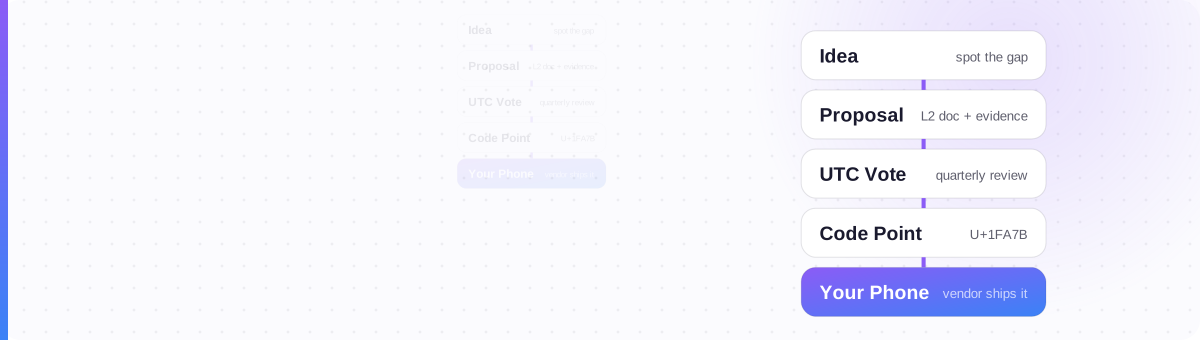
First, What "A New Symbol" Actually Means
It's easy to picture Unicode as an art department that draws new emoji. It isn't. Unicode is closer to a phone book: a registry of numbered addresses, called code points, each permanently tied to one character name. U+1F600 is permanently "grinning face": that fact never changes.
What does change is the picture. Unicode doesn't draw anything. Apple, Google, Samsung, Microsoft, and every other vendor each design their own artwork for that address, in their own font, in their own style. That's why 😀 looks slightly different on an iPhone than on an Android phone: same code point, same name, two independent drawings of it.
The formal name stays put, but the label your keyboard shows does not have to. Unicode freezes the formal name, while the short name that screen readers and emoji search use can be revised. Our emoji name study compares the two for 1,400 emoji: 68% read the same, and about 1 in 7 differ in a way that changes how you would describe the emoji.
The Two Lanes: Emoji vs. Every Other Character
"Unicode symbol" covers two different journeys that share the same finish line. Which lane you're in decides which form you fill out and which committee reads it first.
Screened first by the Emoji Subcommittee (ESC): a body that exists because emoji get vendor-drawn artwork and heavy public visibility, so they're held to stricter, publicly documented selection factors before the full UTC ever sees them. Typical proposer: anyone, via Unicode's public emoji proposal form.
Reviewed directly by UTC-affiliated technical and script experts: currency signs, punctuation, mathematical notation, and entire writing systems skip the emoji-specific screen and go straight into technical review: glyph shape, case mappings, bidirectional behavior, and whether a script needs its own new block.
Both lanes converge at the same place: the same quarterly UTC vote, and the same ISO/IEC 10646 ratification, before either one is published in a Unicode version.
The Encoding Ladder: How a Symbol Actually Climbs to Your Phone
Strip away the two lanes above and every proposal, emoji or not, climbs the same seven rungs. Miss a rung and the climb stops; nothing skips ahead.
Spot the Gap
Someone (a linguist, a designer, a national bank, a member of the public) identifies a character, symbol, or script that genuinely isn't encoded yet.
Draft the Proposal
Written to Unicode's own template: rationale, sample glyphs (black-and-white and color), a proposed name, and, critically, evidence of real-world need.
Subcommittee Screening
The ESC (emoji) or UTC-affiliated technical reviewers (everything else) check completeness, duplication, and whether the selection factors are actually met.
UTC Candidate Review
The full committee meets quarterly. Emoji climb Provisional → Draft → Final Candidate; general characters move from "accepted in principle" onto the public roadmap.
Public Review + ISO Ballot
Draft additions post as a Public Review Issue for open comment, while ISO/IEC JTC1/SC2/WG2 ballots the same repertoire into ISO/IEC 10646 in parallel.
Publication + Code Point
The UTC locks the character into a specific upcoming version and assigns it a permanent hex address. It ships in the next annual release, usually every September.
Vendor Implementation
Apple, Google, Samsung, Microsoft, Meta, and everyone else independently design and ship their own glyph, the step users actually see, typically 6–12+ months later.
Who Actually Makes the Decision
No single person or company approves a symbol. Four bodies share the decision, each with a distinct job:
- Unicode Technical Committee (UTC): the practical decision-maker. Voting membership is made up of organizations (major tech companies among them), and it meets quarterly to move proposals through candidate status to final approval.
- Emoji Subcommittee (ESC): a working group under the UTC that exists solely to screen emoji proposals against selection factors before they reach the full committee.
- ISO/IEC JTC1/SC2/WG2: the international standards side. National body delegates (like ANSI for the US) ballot the same additions into ISO/IEC 10646, the parallel standard Unicode is contractually kept in sync with.
- Script & technical experts: for scripts, currency signs, and technical symbols, subject-matter reviewers vet glyph shape and character properties before the UTC votes.
Approval is a vote, not a single gatekeeper's call, which is also why a strong proposal with weak supporting evidence can still stall for a cycle or two.
What Gets Approved: and What Gets Rejected
This is the part most first-time proposers get wrong: rejections are almost never about the artwork. They're about failing one of these factors.
| Factor | Works in your favor | Works against you |
|---|---|---|
| Real-world usage | Documented, frequent existing use: informal workarounds, publications, community demand | No evidence beyond "it'd be nice to have" |
| Distinctiveness | Visually and conceptually unique from anything already encoded | Just a color, pose, or minor variant of an existing character |
| Compatibility | Fits existing naming and format conventions cleanly | Overlaps confusingly with an existing glyph or sequence |
| Scope | A general concept many people could reasonably use | Overly specific to one brand, meme, or moment |
| Longevity | Likely to still matter in ten years | Trendy or faddish, tied to a passing moment |
| Neutrality | Generic and representational | An exact depiction of a real logo, trademark, deity, or specific person |
| Completeness | Fills a genuine gap in an existing set (e.g. a missing variant) | Adds nothing functionally different from what already exists |
How to Actually Submit a Proposal, Step by Step
This is the part that matters if you actually want to try. Treat it as a checklist, in order.
- Confirm which lane you're in. Is this an emoji (a pictograph meant to be drawn by vendors) or a "regular" character, symbol, or script? This decides which form you use and which committee reads it first.
- For an emoji, use Unicode's official emoji proposal process at unicode.org/emoji/proposals.html. You'll need: a short written rationale, sample images in both black-and-white and full color at multiple sizes, a proposed name and keywords, and, the part people skip, real evidence of demand.
- For a general character or script, write a full proposal document following the Proposal Summary Form used in Unicode's public document register at unicode.org/L2/. Include the character name, a requested code point range, glyph images at multiple sizes, technical properties (general category, bidirectional class, case mappings, decompositions), and citations of existing published usage. If you also want ISO/IEC fast-track consideration, route a copy through your country's national standards body (e.g. ANSI in the US) alongside the direct UTC submission.
- Build your evidence file before you write a single sentence of rationale. The strongest proposals cite: published dictionaries or style guides, existing informal encodings people already use as workarounds, frequency or search-trend data, and, where relevant, letters of support from linguistic or cultural organizations.
- Submit, then expect a wait. Proposals are logged as public documents in the L2 register with their own tracking number. Nothing about this process moves instantly, and a proposal can sit for a full quarter before it's even discussed.
- Track the quarterly UTC meeting calendar. That's the only point in the cycle where your proposal's status can actually change: there's no other checkpoint to watch.
- Respond to feedback fast. If the (E)SC comes back asking for a redrawn sample, more evidence, or a narrower scope, a quick turnaround keeps you in the next review cycle instead of slipping a full quarter behind.
- Know what you're not responsible for. You don't design the final on-screen glyph, you don't need a working font, and there's no submission fee. Unicode ratifies the identity: the code point and the name. The artwork is every vendor's job, done independently, after publication.
Worked Example: The UAE Dirham Symbol
Every rung of the Encoding Ladder above is visible in a single live case we track: the UAE Central Bank's new dirham currency symbol, unveiled in March 2025 and submitted for encoding shortly after. It cleared draft, subcommittee review and the UTC vote, which assigned it U+20C3 on July 22, 2025, and then came through Unicode 18.0's public beta unchanged. Rung 6 followed on September 16, 2026, when Unicode 18.0 published it as UAE DIRHAM SIGN. What it's still waiting on is rung 7: each individual keyboard maker's own decision to actually ship it, and as of September 25, 2026 none has.
See the full status timeline in our dirham symbol update: it's the clearest real-world proof that "approved" and "on your keyboard" are two separate milestones, not one. For how the same publish-then-wait pattern played out with an entire emoji set, see the Unicode 17.0 emoji rollout.
Common Myths, Debunked
"You need to work at Apple or Google." Anyone can submit a proposal for free. The ESC and UTC review on the merits of the document, not the sender's employer.
"Paying money speeds it up." There's no pay-to-fast-track lane. The only thing that moves a proposal faster is stronger evidence and a quick response to committee feedback.
"Once approved, it looks the same everywhere." Unicode approves a code point and a name, not artwork. Every vendor draws its own glyph: that's why the same emoji varies by platform.
"It happens fast." Even a smooth proposal takes 18–24 months minimum from first draft to appearing on a real device, and it's routinely longer.
What to Actually Expect, Stage by Stage
| Stage | Typical duration |
|---|---|
| Drafting + gathering evidence | Your own pace: weeks to months of research |
| Subcommittee screening | Reviewed at the next scheduled meeting |
| UTC candidate review | Quarterly meetings. Status can shift each cycle |
| Emoji candidate ladder (Provisional → Draft → Final) | Roughly a year, one review cycle per stage |
| Public Review Issue period | Several weeks per issue |
| ISO/IEC ballot | Runs in parallel, several months |
| Included in next Unicode version | Annual release, typically every September |
| Vendor implementation | 6–12+ months after publication |
| Total: idea to your phone | 18–24 months minimum, often 2–3 years |
It reserves the address, and votes on whether it deserves one.
The picture is every vendor's job: the identity is the only thing you're actually proposing.
See what's already been approved
Every symbol that made it through this exact pipeline is searchable, one lookup at a time: codepoint, meaning, and history included.
Browse Approved Unicode Symbols →