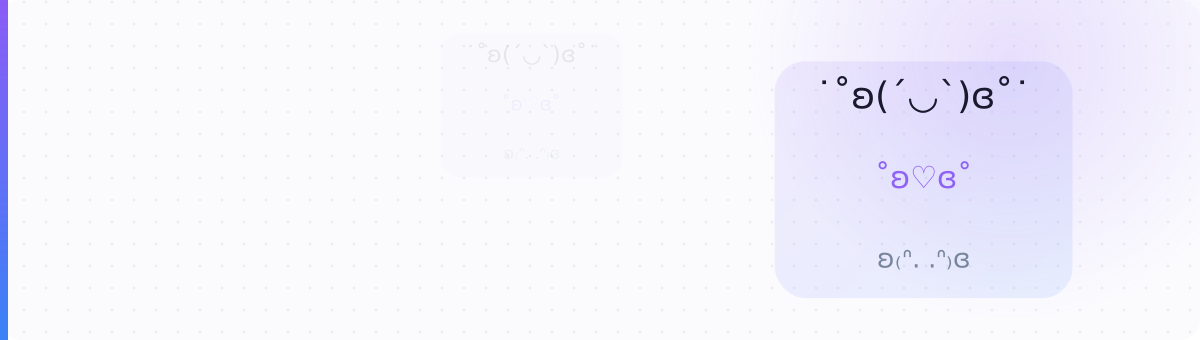
Text faces with wings: ଘ(੭ˊᵕˋ)੭, ꒰ঌ ໒꒱ and ʚ ɞ wing frames, and angels holding a wand. Click any face to copy it.
An angel kaomoji is a text face with wings drawn from letters of other alphabets. The Odia letters ଘ and ଓ curl outward like a wing on each side, ੭ is a Gurmukhi digit that reads as a raised arm, and pairs like ꒰ঌ ໒꒱ or ʚ ɞ frame the whole face like a pair of wings. Every face below is plain Unicode text, so it pastes into a bio, caption, comment or chat like any other character. Unicode has no halo character of its own, so for a halo use the 😇 emoji on the halo emoji page linked at the bottom.
The classic angel shape: a wing on the left and a raised arm or second wing on the right.
Here the wings wrap the whole face. ꒰ঌ and ໒꒱ come from Yi, Bengali and Lao, and ʚ ɞ are two rounded Latin letters that face each other.
A wing on one side and a wand on the other, for a wish, a blessing or a little bit of magic in a message.
No face, just the wings. Put one before or after a name, or at the end of a caption.
It is an angel: ଘ is the wing, ˊᵕˋ is a smiling face and the two ੭ are arms raised in a wave. People send it to mean something sweet or innocent, or as a thank-you.
No. Unicode has no halo character, and plain text cannot stack one character above another reliably. Use the 😇 emoji beside the face instead.
Each face needs a font for every script it borrows from: ଘ and ଓ are Odia, ੭ is Gurmukhi, ꒰ ꒱ are Yi and ໒ is a Lao digit. A device without one of those fonts draws a box in that spot. The Smiling Angel ˙˚ʚ(´◡`)ɞ˚˙ and the Winged Heart ˚ʚ♡ɞ˚ use only Latin letters and common symbols, so they are the safest choice when you cannot check the reader's device.
The UltraTextGen kaomoji generator filters the parts by mood, then lets you swap the outline, eyes and mouth and add cheeks or arms, keeping the left and right sides matched. Every part is plain Unicode text, so the face pastes wherever you are typing.
Open the kaomoji generator →