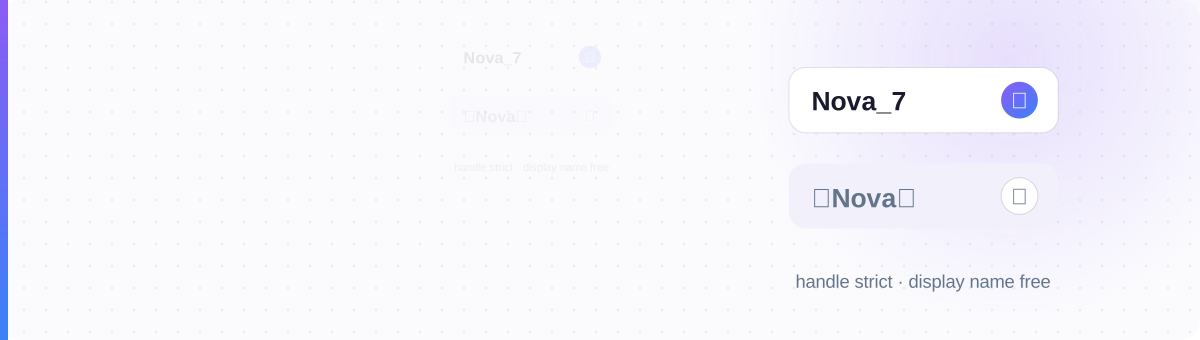
"Rejected" Is a Diagnosis, Not a Verdict
You crafted the perfect name (꧁ᏕᏂᎯᎠᎧᏇ꧂, say) hit confirm, and the game threw it back at you. Or worse: it accepted the name, and your squad later told you it shows up as Shadow with the wings amputated. The instinct is to conclude "this game doesn't allow symbols." That conclusion is wrong far more often than it's right.
Here's the pattern behind almost every rejected gamer name: games don't have one name: they have layers of names, and each layer has its own rules. When a name bounces, one of exactly three things happened:
- Wrong field. You put symbols into the account username (login handle) when the game only allows them in the display name. Roblox is the classic case.
- Wrong place. You're editing the name in-game when the real control lives on an account website: Fortnite names are changed on the Epic site, not in the lobby.
- Silent filter. The name was accepted at creation, but a specific mode, lobby, or client strips the symbols when displaying it. COD is notorious for this.
Work out which of the three you hit, and the fix is usually five minutes. Skip the diagnosis, and you'll waste a paid name change, or abandon a name the game would have taken happily one field over.
The four deep-dives below are the PC and console games people hit most. If you're on mobile (Free Fire, PUBG Mobile or Mobile Legends) the same three failure modes apply, but the character limits are far tighter; see why was my game name rejected for those.
The Username-vs-Display-Name Rule
One principle explains the strictness of every name field you'll ever meet: account handles are infrastructure; display names are decoration.
Your handle is used for login, friend requests, support tickets, ban records, and URLs. Platforms lock it to plain ASCII (letters, numbers, maybe an underscore) for three hard reasons: impersonation (a Cyrillic "а" is pixel-identical to a Latin "a", which is how scammers clone names), moderation (a report against ꧁꧂ᶜᵃⁿ'ᵗ᭄ᵗʸᵖᵉ꧁꧂ is a report nobody can act on), and searchability (nobody can friend a name they can't type). This is the same reason recruiters' software chokes on styled text: the machine layer wants plain characters. If you're curious why styled letters are technically different characters at all, see how Unicode fonts actually work.
The display name sits on top of that infrastructure. It's cosmetic, changeable, and moderated after the fact instead of validated up front, so that's where platforms can afford to allow Unicode. When symbols get rejected, your first move is always the same: stop fighting the handle and find the display layer.
The Game-Name Rules Matrix
Before you burn a name change (several of these cost money or are rate-limited), check the row you're actually editing. "Plain symbols" means keyboard characters like _ - .; "styled Unicode" means generator characters like 𝕏, ᴠ, ꧁ ꧂ or ツ.
| Name field | Length | Plain symbols | Styled Unicode? | Where you change it |
|---|---|---|---|---|
| Roblox username | 3–20 | One _ max, no spaces | ✗ Never | Account settings (paid, in Robux) |
| Roblox display name | 3–20 | Slightly looser, moderated | Partial — filtered | Account settings (free, rate-limited) |
| Fortnite / Epic display name | 3–16 | - _ . and a few more | Some; no published list | Epic Games website, not in-game |
| PSN Online ID | 3–16 | - _ only | ✗ Never | PlayStation settings (first change free) |
| Xbox Gamertag | 12–15* + #suffix | Spaces, apostrophes | ✗ Never | Xbox settings (first change free) |
| Valorant Riot ID | 3–16 + tag | Letters and numbers | Undocumented, test first | Riot account page (free, cooldown) |
| COD Activision ID | up to ~20 | _ - and a few more | ✗ + silent display filter | Activision account (limited free tokens) |
| Steam persona name | up to ~32 | Nearly anything | ✓ Very permissive | Steam profile (free, anytime) |
Read the matrix vertically and the Username-vs-Display-Name Rule jumps out: the strict rows (Roblox username, PSN, Xbox, Activision ID) are all account handles. The looser rows (Epic display name, Steam persona) are display layers. The Riot ID sits in between: it does double duty as handle and display name, with a #tag for searchability, and Riot documents letters from any script for the name half, not symbols.
*As of Microsoft's July 2026 Xbox console update, a Gamertag can run up to 15 characters, but only if it's unique, available, and uses Latin characters. A Gamertag needing a numeric #suffix, or written in a non-Latin script, still caps out at the old 12-character limit. See our Xbox Gamertag update for the full breakdown.
The Four Games That Generate the Most Confusion
Roblox: you're editing the wrong field
The Roblox username takes 3–20 characters: letters, numbers, and at most one underscore, which can't lead or trail. No spaces, no symbols, ever. But the display name, the name that actually floats above your avatar in-game, is a separate, looser field that you can change for free. Nearly every "Roblox rejected my name" post is someone hammering symbols into the username box while the display name box sits untouched below it.
Fortnite: you're editing in the wrong place
There is no name editor inside Fortnite. Your in-game name is your Epic Games display name, changed on the Epic account website and rate-limited (roughly one change per two weeks). Epic accepts letters, numbers, a plain-symbol set (hyphens, underscores, periods) and some other special characters, but publishes no list of which ones. Glyphs Fortnite can't show turn into boxes, diamonds or question marks, and players report gothic (Fraktur) letters coming out as ?. And if you play on console, there's a second trap: PlayStation and Xbox lobbies show your PSN ID or Gamertag instead, which follow Sony's and Microsoft's stricter rules no matter what your Epic name says.
Valorant: letters from any script, symbols untested
Riot's player support describes the Riot ID game name as 3 to 16 alphanumeric characters with a 3 to 5 character tagline, and its developer docs add that any Unicode letter is supported. A katakana letter like ツ falls under that documented rule. Styled characters like ᴠɪᴘᴇʀᴍᴀɪɴ#ACE or 𝕵𝖊𝖙𝖙#EU1 are not documented as accepted, and players report them sticking for some and blocked for others. Accented letters can count as the plain letter, so Café and Cafe may collide. Run the name through the Valorant name generator's checker first, and save heavier styling for a properly styled nickname on a field that accepts it.
COD: accepted at the door, filtered in the room
The Activision ID accepts letters, numbers and a handful of plain symbols, and then applies a second, invisible layer: an in-game filter that strips or replaces characters in some modes and lobbies. This is the purest form of the third failure mode, and it deserves its own section.
The Silent Filter: Accepted at Creation, Blanked in the Lobby
This is the one that genuinely baffles people, because it looks like the game is contradicting itself. Your name passes validation. It shows correctly on your profile. Then in a ranked lobby, or on a killfeed, or on a teammate's console, the symbols are gone, or the whole name reads as Player.
Nothing broke. Validation and display are two different systems. The account service checked your name once, at creation, against its own rules. But every surface that shows the name (each mode, each platform client, each UI widget) can apply its own stricter display rule, and cross-platform lobbies inherit the strictest rule in the room. Your name is stored intact; that surface just refuses to paint part of it.
ᴠᴇɴᴏᴍ࿐: stored exactly as you created it, renders perfectly on your own screen.
ᴠᴇɴᴏᴍ or just Player: the display filter dropped what it couldn't (or wouldn't) render.
ᴠᴇɴᴏᴍ□: no filter at all, just a missing glyph. A different problem with an identical symptom.
Note that third card: a symbol vanishing into a box isn't the game filtering you: it's the other player's device lacking the glyph. Same amputated name, completely different cause. Why fonts show as boxes covers that failure in depth. Discord servers have their own version of this per-surface behavior too. See where fonts work on Discord.
How to Test a Name Without Burning the Change
Name changes are a scarce resource: Roblox charges Robux, Epic locks you out for two weeks, Activision meters out tokens. So test before you spend:
- Paste it into the game's player search first. This is the cheapest, most honest test there is. If the search box rejects or mangles the characters, so will half the game's UI, and no teammate will ever be able to look you up.
- Build the name in a generator, not in the rename dialog. Assemble and preview symbol combinations in a nickname generator or, for team prefixes like ꧁ᴛᴇᴀᴍ꧂, a clan tag generator, then paste the finished string once.
- Check it on a second device. Your phone rendering the name proves nothing about a teammate's console or an older Android. One look on the worst device you can borrow tells you more than ten looks on your own.
- Keep a plain-ASCII core. If the symbols get stripped, ꧁Venom꧂ degrades to Venom, still you. A name that is only symbols degrades to nothing.
When You Shouldn't Use Symbols at All
A guide that only tells you how to sneak symbols in would be doing you a disservice. There are real costs, and sometimes the right call is a clean plain name:
- Tofu on other people's screens. Every styled character is a bet that the viewer's device owns the glyph. Lose the bet and your name is a row of □□□ to your own squad.
- Unreadable names get reported. A name nobody can type is a name nobody can friend, invite, or vouch for, and in report-happy lobbies, "unpronounceable symbol soup" reads as "probably a cheater's throwaway."
- Competitive play forces plain names. Tournaments, esports clients and many ranked ladders require readable, castable names: organizers won't put ꧁꧂ on a broadcast overlay. If you have competitive ambitions, make the plain version of your name the real one.
- Filter evasion is the actual offense. Symbols aren't bannable; using them to impersonate a streamer, fake a staff tag, or smuggle a slur past the profanity filter is. Moderators judge intent, and lookalike characters are evidence of it.
The mature move: symbols on the display layer of casual games, plain text everywhere that's infrastructure. That's not a compromise: it's using each layer for what it's for.
It rejected the field you put them in.
Find the display layer: that's where Unicode lives.
Generate a name that passes the filter →
Build your styled name from characters that survive the strictest lobby you play in: preview it, copy it once, and paste it into the right field.
Open the Nickname Generator →