"My Reach Dropped, It Must Be the Font"
It's a familiar chain of reasoning: post engagement dips, and the most recent visible change (a styled name, a fancy bio, a bold caption) gets blamed. It's the same post-hoc logic behind the Instagram shadowban myth and the LinkedIn "does bold hurt reach" panic, and it doesn't hold up any better here.
No platform's stated ranking factors, help-center documentation, or leaked algorithm details mention styled Unicode characters as a reach or ranking signal. Search engines' own guidance on ranking factors focuses on content quality, relevance, and technical fundamentals, never character styling. If styled text carried an algorithmic penalty, it would be one of the most consequential and easiest-to-fix SEO issues in existence, and no major SEO resource treats it as one.
Search Doesn't Penalize Styled Text: It Just Doesn't Match It
Here's the fact that actually explains everything: search indexes work by exact character matching. When someone types "hello" into a search box, the system looks for the code points U+0068, U+0065, U+006C, U+006C, U+006F. A styled "𝗵𝗲𝗹𝗹𝗼" is built from an entirely different set of code points in the Mathematical Alphanumeric block. To a search index, these are not the same word rendered differently: they're two unrelated strings that happen to look similar to a human eye.
No suppression, no demotion: just a string that never enters the candidate pool in the first place. This is the same mechanism explained in the pillar guide's Four-Layer Model: the style is the characters, not a costume worn by the plain ones.
The Searchability Tax
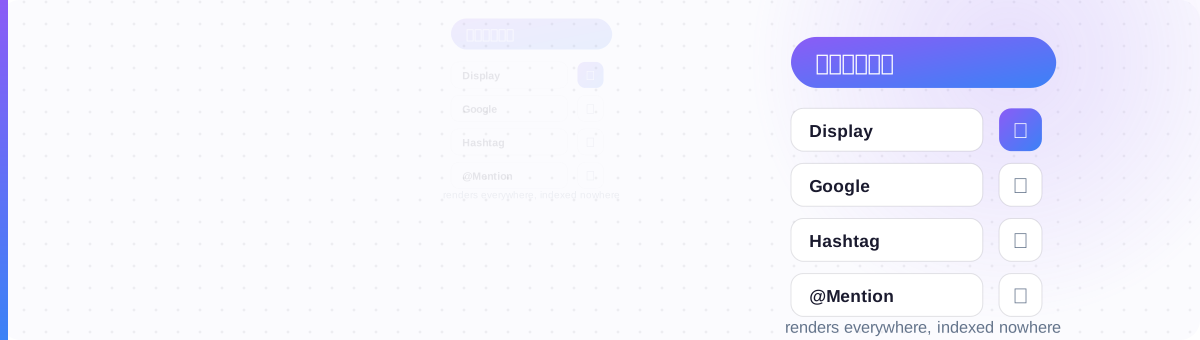
Every styled character you use pays a small, predictable tax: it becomes invisible to systems that match text exactly. Here's where that tax gets charged.
Web search
Google and other search engines index the literal characters on a page. A styled headline or name won't surface for a plain-text query of the same words.
In-app search
Instagram, TikTok, Discord and LinkedIn's own search bars work the same way: searching "Sarah" will not surface a profile styled as "𝓢𝓪𝓻𝓪𝓱."
Hashtags
A styled hashtag doesn't join the plain-text hashtag's feed. It creates its own tiny, disconnected one that almost nobody will ever browse to.
@Mentions
Autocomplete when someone types "@" matches plain characters. A styled username or display name is often difficult or impossible to mention by typing.
Real Cost vs Myth Ledger
- An algorithm penalizes or suppresses posts for using styled text
- Styled text "flags" your account for reduced reach
- Styled names and keywords don't surface in exact-match search
- Styled hashtags fragment your reach instead of joining the real one
- Screen readers mangle styled words letter by letter
- Heavy lookalike-character use is one signal some spam filters weight
Keep the Findable Parts Plain
This isn't a case for avoiding styled text. It's a case for placing it deliberately. Anything you want a stranger to be able to find by typing should stay in plain characters. Anything purely decorative can carry style with no real cost.
- Keep plain: your name/handle, business or brand keywords, hashtags you want to rank in, link anchor text.
- Style freely: a bio's decorative line, an emphasis word inside a caption, a divider or header, a one-off post flourish.
This is the same discipline as the Plain-Core Rule from the accessibility guide: the searchable core of your text and the accessible core of your text turn out to be the same thing.
It's simply never in the running.
Keep the words people search for in plain text. Style everything else.
Style the decoration, not the keywords
Generate a styled accent for your bio while keeping your name and keywords searchable in plain text.
Open the Bio Font Tool →